How to Check Zoning of a Property (Florida Counties)
Find the parcel on the zoning map, write down the district code, then read that district in the zoning code.
To check the zoning of a property, find the parcel on the county or city zoning map, write down the district code, then read that district in the zoning code for permitted uses, minimum lot size and setbacks. The map only gives you a code, so the code text is what tells you whether a house, a mobile home or an RV is allowed.
A zoning code on a county map only points to the rules. Those rules decide whether your end buyer can put a house, a mobile home or an RV on the lot, which moves your resale price, buyer pool and time on market. Read the district rules on every parcel before you make an offer.

Quick check before you buy
- 1.Find the parcel on the county or city zoning map and write down the district code (R-1, AG, A-1 and so on).
- 2.Confirm which government zones the parcel. Inside city limits, the city's zoning applies, not the county's.
- 3.Look up that exact district in the zoning code. Do not trust a code from another county, even if it looks the same.
- 4.Find the minimum lot size and check it against your parcel's acreage.
- 5.Check whether mobile or manufactured homes are allowed on this lot.
- 6.Check whether RVs or camping are allowed.
- 7.Note the minimum home size and the setbacks.
- 8.Check for deed restrictions or an HOA. They can be stricter than zoning.
- 9.Call the county planning department on anything unclear.
- 10.Price for the buyers who are left after the rules.
Check it yourself, step by step
You need a parcel number or address and a browser. Every county builds its site differently, so the menu and layer names below are typical and yours will differ.
Step 1. Open the county's zoning map. Search the county name plus "zoning map" or "GIS." Many counties have an interactive map with a zoning layer, and some post a PDF map. For a parcel inside a city, use the city's planning or zoning website. The Florida list below covers four counties.
Step 2. Find the parcel. Search by parcel number (APN) or address. Vacant land often has no street number, so use the parcel number. Check that the highlighted shape matches the parcel you are buying.
Step 3. Turn on the zoning layer and read the district code. Click the parcel and write down the code, or both codes if it straddles two districts.
Step 4. Check for overlay layers. Some parcels carry extra layers on top of the base zoning, such as environmental protection, historic, airport noise or wellfield protection overlays. They usually appear as separate map layers, which makes them easy to miss. Overlays can limit building height, require buffers, limit paved area or add design rules.
Step 5. Open the county zoning code. Counties publish their code in different places: some in an online code library, others as PDFs on the planning department site. Search for "[county name] code of ordinances" and look for the zoning or land development chapter. If you cannot tell which version is current, ask the planning office.
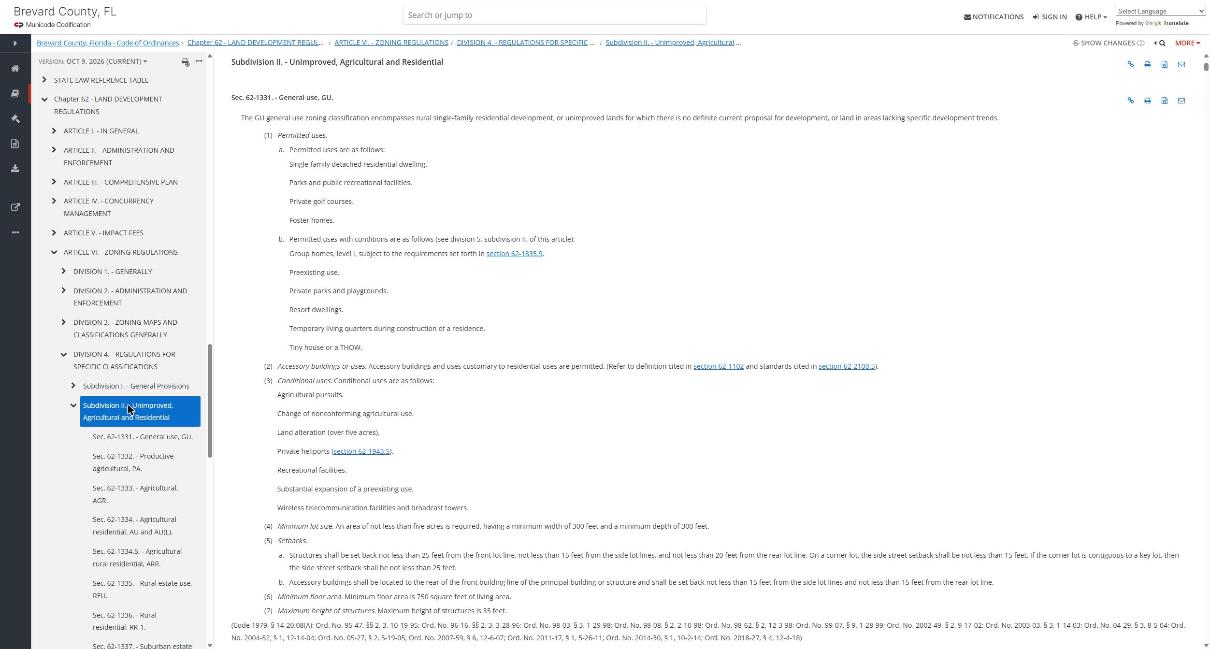
Brevard County Code of Ordinances on Municode, Chapter 62 Article VI zoning regulations (October 2026).
Step 6. Look up your district and read three things. Find the permitted uses (allowed by right), the conditional uses (need special approval) and the dimensional standards (lot size, setbacks, height, coverage).
Step 7. Answer the five resale questions. Write down the answer to each, with the code section number:
- Are mobile or manufactured homes allowed?
- Are RVs or camping allowed, and for how long?
- What is the minimum home size?
- What is the minimum lot size?
- What are the setbacks?
Step 8. Check for deed restrictions and an HOA. The zoning code does not cover these. Search the county clerk's records for the subdivision plat and recorded restrictions. Zoning may allow a mobile home while the deed restrictions ban it, and the stricter rule controls what your buyer can do. Our guide to deed restrictions and HOAs covers how to find them.
Step 9. Call the planning department. If the code is vague, or your use sits in a gray area, call or email the county planning or zoning office. Ask: "For parcel [number] in district [code], is [intended use] allowed by right, a conditional use needing approval, or prohibited?" Save the reply with its date. Only the county can give you a formal answer.
Step 10. Save what you found. Screenshot the map and copy the code sections.
Where to look up zoning in four Florida counties
These are the public pages we checked. Counties change their sites, and cities zone their own land.
- Brevard. The county's Zoning and Future Land Use web application is described as a map for finding the zoning and future land use of county properties, and it notes that cities have their own. The property appraiser's BCPAO map is a quick way to find the parcel first. Questions go to Planning and Zoning at (321) 633-2069.
- Marion. Start with Growth Services, Planning and Zoning at (352) 438-2600 and ask how to see the zoning for your parcel. The county also offers a GIS interactive map through that department on marionfl.org. The Marion property appraiser helps you confirm the parcel number.
- Citrus. The county's GIS interactive maps portal is linked from the Land Development Division page. We could not confirm which zoning layer the portal opens with, so call Land Development at (352) 527-5310 to confirm the district.
- Polk. Polk's Planner on Call answers questions on the Comprehensive Plan and Land Development Code, Monday to Friday, 8 a.m. to 5 p.m., at (863) 534-6084. The property appraiser's interactive map finds the parcel. Ask the planner which future land use or district rules apply to it.
The property appraiser's use code is not zoning
Many buyers read the "use code" on the property appraiser's page as the zoning. The use code is a tax category. Florida property appraisers assign Department of Revenue land use codes to classify property for the tax roll, and the Department's data file guide lists categories such as vacant residential and agricultural. A parcel taxed as agricultural can be zoned for something else, and a parcel with a "vacant residential" tax code can still be too small to build on. The county sets zoning, and the appraiser does not.
Use the appraiser's page for parcel number, acreage and legal description, and the planning department's map and code for zoning.
Why the code on the map is not enough
There is no national zoning standard. Each county and city writes its own districts, terms and rules, so "R-1" in one county can mean something different from "R-1" in another. The code tells you which chapter to read.
The categories, in resale terms
Residential (R-1, R-2, SFR and similar). Usually allows single-family homes. The questions that decide resale are minimum lot size, whether manufactured or modular homes are allowed next to site-built homes, setbacks and height limits, and whether accessory dwelling units are allowed. Some residential districts split single-family detached, attached and multi-family, which changes what your buyer can build.
Agricultural zoning (AG, A-1, Rural). Buyers misread this category most. In many counties, agricultural zoning allows a single-family house as a permitted use. Check three things: the minimum lot size for a home, whether a non-farm house is allowed by right or needs a conditional use permit, and whether manufactured homes are allowed. Some places use strict agricultural districts that really do restrict non-farm building, with very large minimum lots. Only the ordinance text tells you which kind you have.
Unzoned land. Some rural areas, in some states, have no county zoning at all. Ask the county whether the parcel is zoned. Deed restrictions, platting rules, floodplain rules, septic permits and building code can all still apply to unzoned land. Our pieces on Texas counties and the hidden risk of unzoned counties go deeper.
Where investors lose money
Lot too small for the district. A parcel can be classed residential and still be smaller than the district's minimum lot size. Example, hypothetical: a quarter-acre lot in a district requiring half-acre minimums cannot take a house without a variance. Variances cost money and time, and the county can refuse them. The GIS map will not show this, but the dimensional standards will.
Mobile and manufactured home rules. If your end buyer wants a mobile home, this is the check that matters most. Many residential districts ban manufactured homes or confine them to certain districts, and some set larger minimum lots for them than for site-built homes. Read the dimensional standards for that use, and ask the county (or an attorney, if a purchase depends on it) how any ban applies. Check each parcel you plan to sell to that buyer, because "residential" does not always include manufactured homes.
RV and camping rules. Rural buyers often want to park a camper while they build, or to camp on the land. Zoning may limit or ban that, and time limits vary. Read the code for RV use. If the answer is no, say so in your marketing and price for a smaller pool.
Non-conforming use. When zoning changes after a property is already in use, that use is typically grandfathered as legal non-conforming. It usually cannot be expanded, and it may be lost if discontinued for a set period. The county code sets that period, so look it up. Your buyer inherits those limits, which narrows the pool and complicates financing.
Treating zoning as a building permit. Right zoning does not ensure a permit, because permits add their own requirements: building code, environmental review, water or well and septic feasibility, stormwater and fire access. A correctly zoned parcel can still fail a perc test or lack legal road access.
Zoning as a value driver
Some investors buy agricultural land in a growth corridor and apply for a rezone. Rezones take months, carry application fees and often need legal help. Ask the planning office for its fee schedule and timeline. The process is slow and uncertain, and it is a different business from a flip.
Pricing and decision guide
- Zoning allows a house by right, minimum lot size met, mobile homes and RVs allowed, no stricter deed restrictions: full price. This is the widest buyer pool.
- House allowed, but mobile homes or RVs banned: discount for the smaller pool. Skip buyers the rules exclude.
- Conditional use needed, or an overlay applies: discount until the county confirms in writing what it takes to get approval.
- Lot smaller than the minimum, or a variance required: deep discount, or pass unless you are comfortable with the variance process.
- Unzoned land: price on the deed restrictions, platting rules and permit rules that still apply. Check them first.
- Conservation zoning, or a district that bars what your buyers want: pass.
Comp parcels with the same zoning rules as yours: a lot that bans mobile homes does not comp against one that allows them.
Zoning is one check among several. The full list is in The Complete Land Due Diligence Checklist.
Screening a list by hand means a map search and code lookup per parcel.